Last Sunday I said we would tell you more about the next project once The NanoFlux was out the door. The NanoFlux is out the door. So here it is.
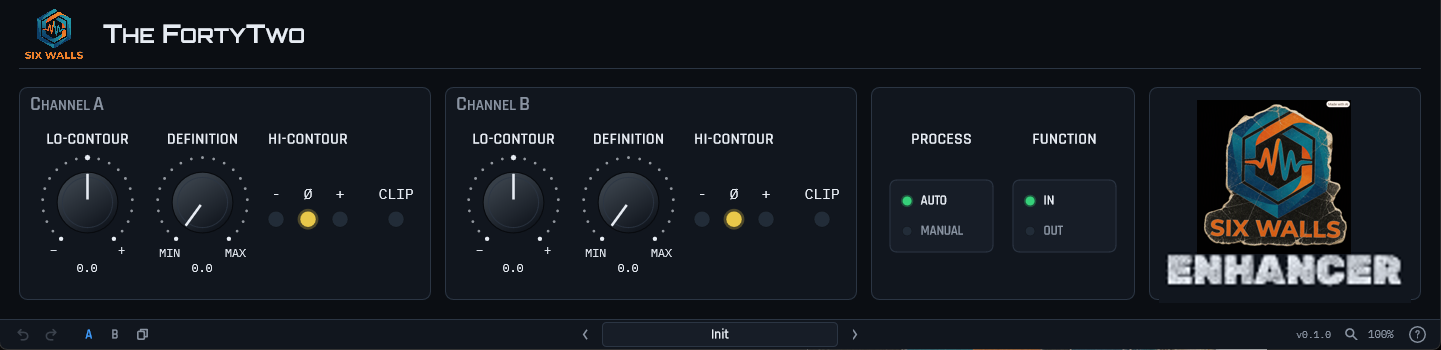
This is The FortyTwo. Forty-two is the answer to life, the universe, and everything,* and it is also what a certain rack unit's model number turns into if you squint at it for long enough. I did mention the answer to the mix and to summing in the last post. I'm a man of my word. If we find the question as well, I'll let you know.
About that screenshot
The FortyTwo is an emulation of an early-'90s rack enhancer. It has two channels. Each has a Lo-Contour knob for the bottom end, a Definition knob for the top, and a little row of lights that tell you what the box is doing to the highs. In the middle sits a switch marked Auto, which is the interesting part. In Auto, the unit listens to what you're playing and decides on its own how much sparkle you need. That's a lot of responsibility to hand a circuit from about 1990.
What exists so far is the face. The knobs turn, the lights light, the buttons click, and the sound behind them is a stand-in that does just enough to keep the lights honest. Nothing in it has been measured yet. Every Six Walls plugin gets its sound from the real hardware, warts included, and we haven't had the hardware.
Tuesday
The hardware arrives on Tuesday. We do have the manual, and it came with the schematic, so we've been reading a circuit diagram for fun. A few things from it:
- The Definition knob doesn't boost the highs directly. It sets how much of a control signal gets through. In Auto, that signal comes from a detector listening to your music. In Manual, it's fixed. That one fact is the whole difference between the two buttons, and it tells us how to go about measuring them.
- The bass boost is a separate path from all of that, which means we can measure it on its own.
- The manual disagrees with itself. The text says the middle position of Lo-Contour is flat. The calibration table at the back says it adds about a decibel and a half at 50 Hz. We'll find out which one is telling the truth when there's a meter on it.
The plan for Tuesday is to unbox it, plug it in, and measure it every way we can think of: tones at every level, noise, sweeps, and a great deal of knob turning, since there are two channels and every knob has to be tried in more than one place. A few of the measurements are there only to catch somebody lying. A bypass switch should be a plain wire, and if it isn't, we want to know whether the unit is off or we are.
We capture it warts and all, of course. If the box has drifted far enough over the years, the warts and all become the Pawn Shop mode, and we'll do our best to compensate for the drift in the regular one. Two channels of essentially the same circuit should help with that. When they disagree, it's a good hint at what the box was meant to do.
Also this week
The Installer picked up a small new habit this week. When it asks our server for something, it now says who it is: its name, its version, and which operating system it's running on. That's all it adds. It means we can finally tell which downloads came through the Installer and which came through a browser, which is a small thing to be pleased about, and I am pleased about it.
In more physical news, the stickers are on order. Fifty of them, matte, with the logo looking like it spent several years on a bass cabinet. (The wear is pre-applied.) I haven't worked out who gets one yet.

* The question, famously, was never found.