Six Walls

Press

Press kit

Descriptions, screenshots, logos, and the basic facts for writing about Six Walls or listing its plugins. Use any of it as is, trim it, or rewrite it. Questions, review copies of nothing (it’s all free already), or anything else: eddy@sixwalls.net.

The facts

Developer
Six Walls (Eddy Jones), Orange County, California
Established
2026
Contact
eddy@sixwalls.net · user support: support@sixwalls.net
Website
sixwalls.net · About
Price
Free. No account, no license key, no telemetry, no copy protection.
Formats
VST3, AU, and AAX
Platforms
Windows 10/11 (64-bit) and macOS (universal: Apple silicon and Intel)
Signing
Windows installers code-signed; macOS signed with a Developer ID and notarized by Apple
Install
The Six Walls Installer, or individual installers on the Support page

About Six Walls

One line

Free plugins from one person in Orange County: measured hardware emulations and studio problem-solvers, in VST3, AU, and AAX for Windows and macOS.

Longer

Six Walls is Eddy Jones, an Art Institute-trained audio engineer who spent thirty years as a software developer and tester and is finally putting the two together. The name comes from the room: a ceiling, a floor, and four vertical walls, the six surfaces that bring sound to life.

The emulations start with real hardware on the bench. The ThirtySix is modeled on an Alesis 3630 compressor and The NanoFlux on an original Alesis NanoVerb, each measured from a real unit and modeled quirks included. The Room and The Overhead(s) started as fixes for problems in real sessions.

Everything is free, with no account and no telemetry. If a Six Walls plugin earns a place in your sessions, the suggested thank-you is a donation to The Miraculous Love Kids.

The plugins

The ThirtySix

v1.2.3 VST3AUAAX
One line

A free dual-channel VCA compressor, limiter, and gate modeled from bench measurements of a real Alesis 3630 (unofficial).

Longer

The ThirtySix is a dual-channel VCA compressor, limiter, and gate modeled on the Alesis 3630, one of the cheap black boxes that filled home-studio racks a generation ago and ended up on a lot of records anyway. It isn’t a clean compressor and isn’t trying to be. The point is the pump, the knee, and the two-stage attack.

Ratio calibration, threshold law, knee, the two-stage attack, release curves, sidechain frequency weighting, and the output noise floor were each measured from a real unit and checked back against it with real program material.

  • Two channels: independent, stereo-linked, or Serial (A into B) for two stages in one insert
  • RMS or Peak detection, hard or soft knee, full threshold, ratio, attack, release, and output controls
  • A downward gate on each channel with its own threshold and rate
  • Independent external sidechain inputs for the compressor and the gate
  • A modeled output noise floor you can dial in or leave at zero
  • Sessions remember the model version they were mixed with, so future updates never change a finished mix
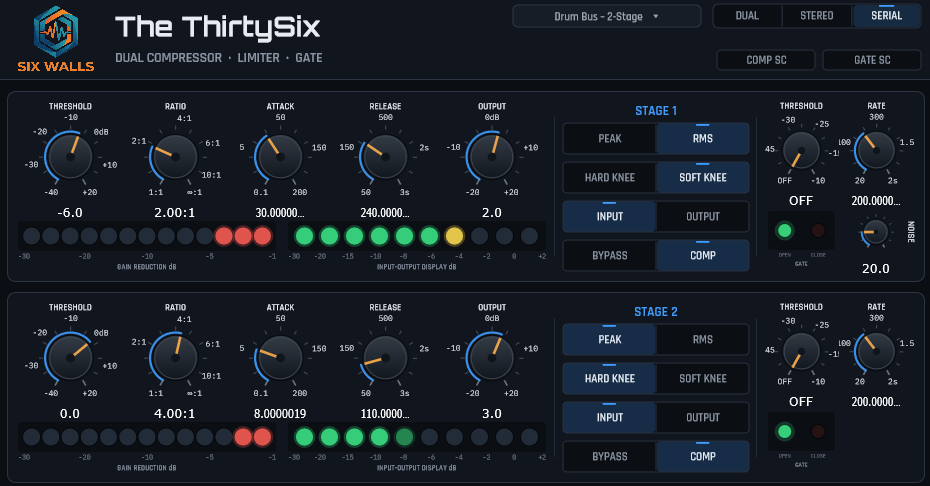
The ThirtySix plugin interface

The NanoFlux

v1.0.0 VST3AUAAX
One line

Free chorus, flange, delay, gated reverb, and rotary, measured from a real original Alesis NanoVerb (unofficial) and modeled warts and all.

Longer

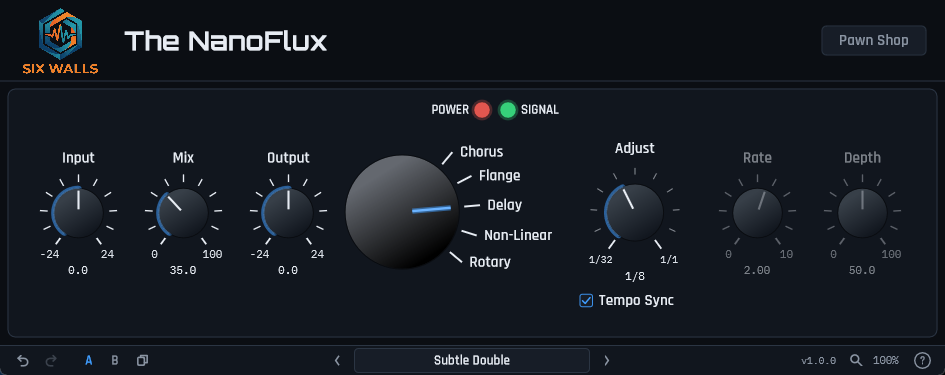
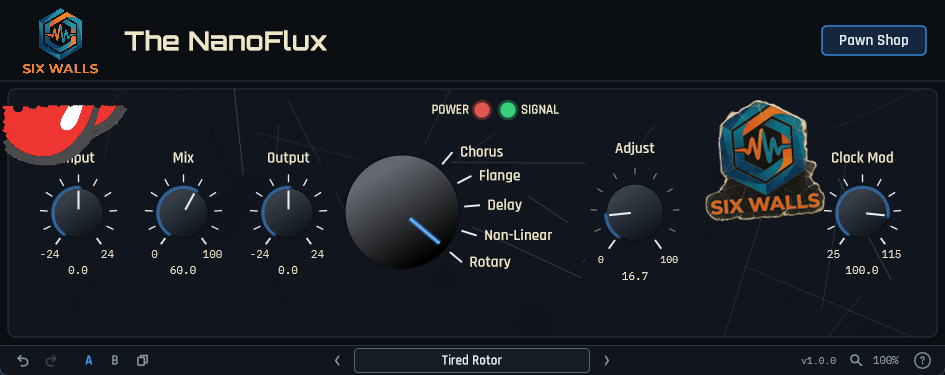
The NanoFlux is the non-reverb side of the original Alesis NanoVerb (unofficial): five programs measured from a real unit, from sweep rates and delay times to filters, gate lengths, rotor patterns, and the Mix pot’s own curve, then checked by ear against the hardware, side by side, on real material. Like the hardware, each program has one Adjust knob.

  • Chorus: true stereo, with the two sides sweeping at different speeds
  • Flange: a feedback comb that freezes into a fixed metallic tone at the bottom of the knob
  • Delay: up to 1.27 seconds in the unit’s own 10 ms steps, or Tempo Sync with fourteen note values, dotted and triplet included
  • Non-Linear: the 1980s gated-reverb snare, from a 145 ms to a 620 ms gate
  • Rotary: a two-speed rotating speaker with the hardware’s quick spin-up and slow coast-down

Turning Adjust all the way up unlocks Custom Rate and Depth beyond the front panel’s range.

Pawn Shop mode is the same box after a hard life: crackly pots, a slightly hot right side, drifting sweeps, a tired rotary motor, and delay-time jumps that splat when you move Adjust. It adds a Clock Mod knob modeled on the most popular real NanoVerb circuit bend, which slows the unit’s clock so everything stretches out darker and hissier.

Zero latency, factory presets included.

The NanoFlux plugin interface

The Room

v1.1.4 VST3AUAAX
One line

A free convolution room emulator you play by dragging a microphone around a measured space.

Longer

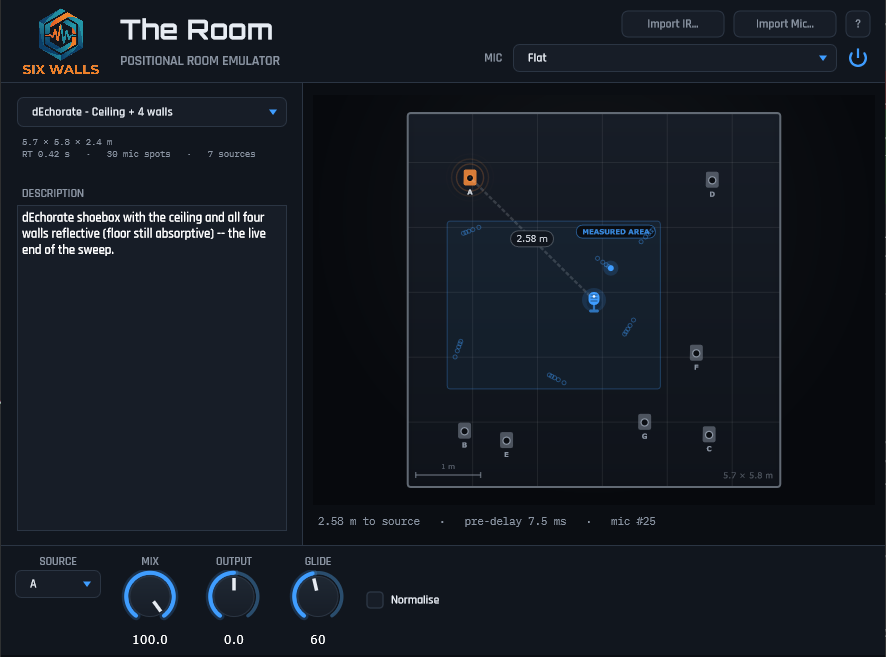
The Room convolves your signal with a bank of measured room impulse responses instead of an algorithmic reverb, and you play it by dragging a microphone around a top-down view of the space. Pre-delay, tone, and level all follow the mic position, the way they do in a real room. The nearest measured response is crossfaded in as the mic moves, and Mic X and Mic Y are automatable, so you can sweep the mic through the room from your DAW.

The measured rooms include a small treated room, a stone great hall, a domed octagon, a classroom, and a shoebox with progressively more reflective surfaces.

A mic selector picks one of twelve microphone models, from vintage broadcast dynamics to modern large-diaphragm condensers, each with its own voicing over the measured room. You can also import your own .mic profile, made with the free Room Mic Capture app.

The Room plugin interface

The Overhead(s)

v1.2.2 VST3AUAAX
One line

A free plugin that reduces kick, snare, and tom bleed in your drum overheads, the mirror image of a de-bleed tool.

Longer

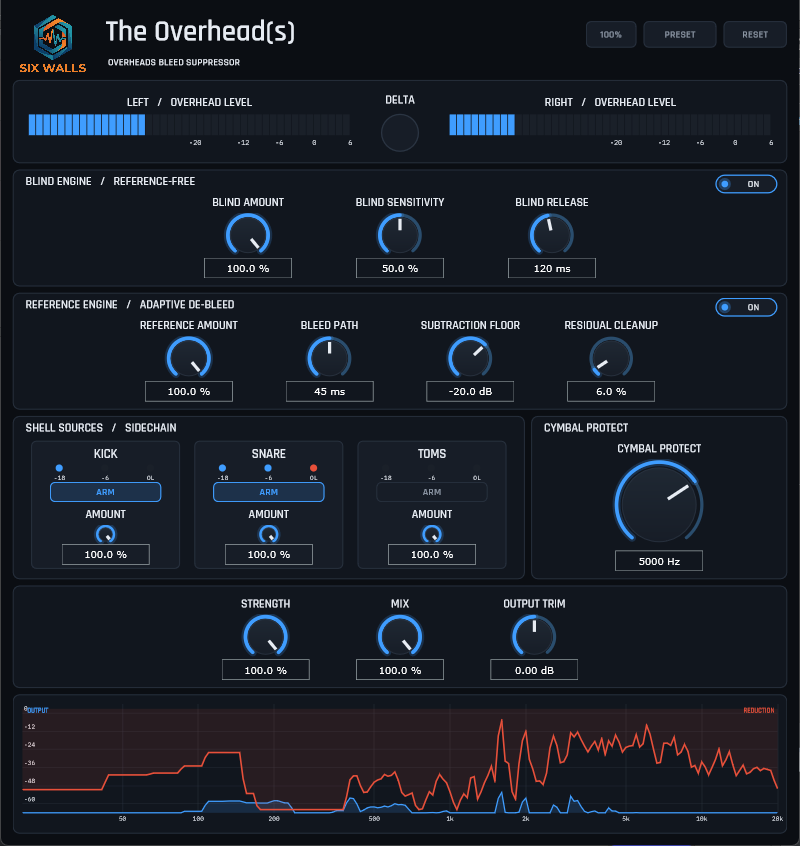
The Overhead(s) reduces kick, snare, and tom bleed in your overhead mics, giving you more control over the shells in your mix. It’s the mirror image of a de-bleed tool that strips overhead spill from the close mics. Because the cymbals share the same broadband, transient territory, it works on the drum hits themselves rather than with a static EQ cut, and Cymbal Protect keeps the cymbals’ brightness untouched.

  • Blind engine: needs no reference. A linear-phase STFT ducks shell-hit energy and tapers back above a tunable Cymbal Protect crossover.
  • Reference engine: feed in the kick, snare, and tom close mics, and an adaptive filter learns each spill path and subtracts it.
  • Run either engine alone or both in series, with delta monitoring to hear exactly what was removed.

Fixed latency of about 85 ms, reported to the host for delay compensation.

The Overhead(s) plugin interface

Also free: Tools for Studio One, a suite for archiving, backing up, renaming, and repairing PreSonus Studio One and Fender Studio Pro song projects; and The Room Mic Capture, for measuring a microphone into a profile The Room can use.

Coverage

Logos

Six Walls logo with wordmark
Logo with wordmark 860×673 PNG, transparent; for light backgrounds
Six Walls hexagon mark
Mark only 300×356 PNG, transparent
Six Walls worn sticker logo
Worn sticker 480×476 PNG, transparent
Six Walls banner
Banner 1200×630 PNG, social-card size

Trademarks

Alesis, 3630, and NanoVerb are trademarks of their respective owners. Six Walls is not affiliated with or endorsed by Alesis; the hardware names are used only to describe the units that were measured.