Last time I said the hardware would arrive on Tuesday. It arrived on Tuesday. Nothing that happens on schedule in this business is allowed to go unmentioned.
The FortyTwo
Work continues on The FortyTwo, and most of it now is the unglamorous kind. The unit is measured. What's left is tuning the output, over and over, until the plugin comes as close to the hardware as we can get it. We're mathematically close on pretty much every measurement at this point, so now we're tuning by ear. That's the arduous part. By ear we've already found several things that were wrong even though the math said they were right.
One example. The Auto switch turned out to be a little more complicated than it looks from the front. The circuit behind it listens at two speeds at once: part of the reaction is almost immediate, and the rest follows along a quarter of a second later. Our first guess at its timing was fine on sustained notes and wrong on drums, where the plugin barely backed off at all. With the new timing, the toms and the snare land within a fraction of a decibel of the real box. That's on paper, though. The next step is to listen to it.
The other task is the pile of small things that nobody notices until they're wrong: the clip light, what the meters read, what a knob does halfway between two clicks. The plugin should misbehave in the same places the hardware does, and not in any new ones.
No release date. It's done when it matches.
The Principle
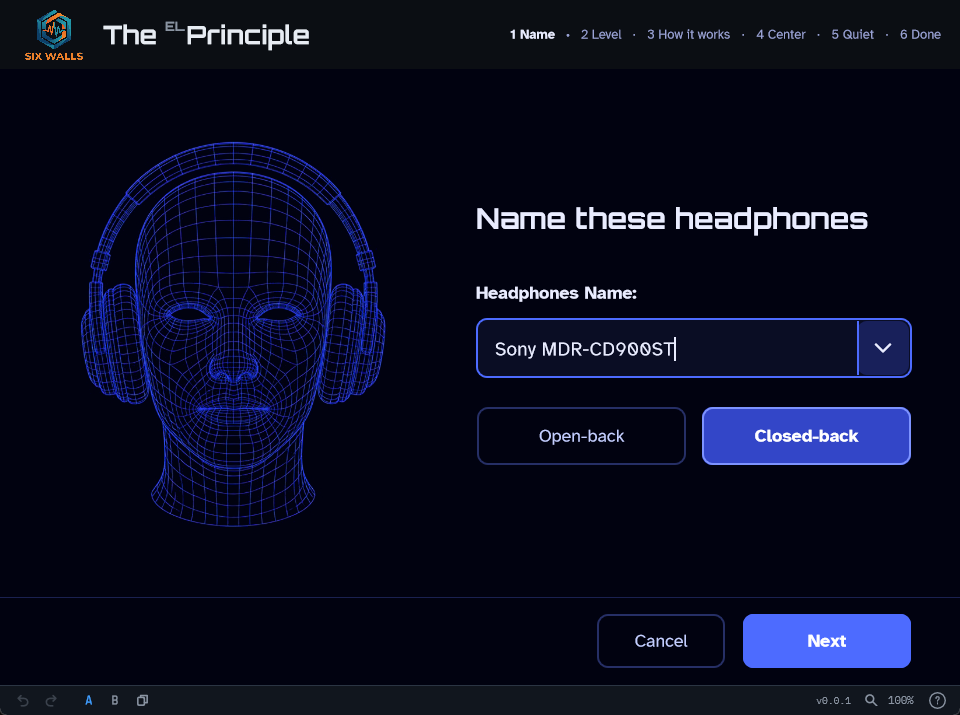
A few weeks ago I mentioned a tool for the Listen bus that I'd dreamed up in my sleep. It has a name now. It's called The Principle, after the equal-loudness principle, which says that our ears don't hear every pitch at the same strength. (Its previous name was a pun on that. Nobody else enjoyed it, including me, eventually.)
Here's what it does. You put on the headphones you mix with. A band of noise plays, and you nudge it left or right until it sits dead center in your head. Then you do that for ten bands, from low to high. Each band gets asked twice, and a third time if your two answers don't agree. A second pass at a much quieter level catches what changes when things get soft. This is not a hearing test. It never asks whether you can hear anything. It only asks where the sound seems to be.
From those answers, The Principle builds a separate EQ for each ear, so that something panned to the center stays in the center while you're mixing. It only changes what you hear on the Listen bus, and never the mix itself. Each pair of headphones gets its own profile, because each pair of headphones is unique and your ears hear them in a unique way. So, each set of headphones needs its own calibration. There's also a Fit Check, a one-minute test that tells you whether the headphones are sitting right today, since a pair that's an inch off will balance differently.
The calibration wizard is intuitive. You use your keyboard arrow keys to move the sound left and right and hit Enter to submit when you're ready. There are a few other options, but they are spelled out on the page.
Thanks for listening.